Thursday, July 19, 2012

Sign of the Packhorse


As our wee sprog grows, Stephen and I have looked for shorter and easier hikes to get out and do before our lifestyle is altered drastically. We have also been asked by friends of ours, with no tramping experience, if they might join us on one of our trips. So, we checked out one of our new favorite tramping resources, tramper.co.nz, and chose a nearby, accessible hike with a great sounding hut at the end of it - Sign of the Packhorse.

Originally built as one of a series of rest stops on a proposed road from Christchurch to Akaroa via the top of the Banks Peninsula, this stone hut has been preserved by DOC as great place to escape to for  a picnic lunch or overnight. Nestled in Kaituna Pass, just below Mount Bradley, the cosy 9-bunk hut has expansive views out over Lyttleton Harbor and out towards Te Waihora - Lake Ellesmere. There are numerous routes into the hut, each with their own pros and cons. We chose the route from Gebbies Pass as it gained the least amount of elevation and was the closest access point. This route passes through several farmers properties, mostly through forestry lots, and promised to be an environment neither Stephen, nor I had tramped through before.


We met up with our friends a couple of days before and told them what they might need to pack, gave them a map of the area, and together we went over our planned route. It's great fun introducing someone to something you love and we were keen to make this trip as enjoyable and pleasant as possible so they might continue to tramp in the future. After passing on some spare sleeping bags and packs, we got to sorting the food and packing up ourselves. I say "we", but really, I am allowed to carry very little these days. In fact, I think the sum total of my pack included one mug, my water bottle, some snacks, two books and 4 pencils. Oh, and the first aid kit.

As the tramp is so close to home, there was no rush on the morning of our departure - another bonus point for making tramping accessible. We eventually made it out the door with everyone in tow by 11am and were driving the 30 minutes to our trail head. As soon as we dropped into the Lyttleton Harbor we were greeted by a wall of thick fog. As we arrived at the pull off, we also noted a sign on the gate informing us of ongoing logging and an alteration in the trail to avoid issues. Hmmm, we'd never been tramping through a logging site before. This should be interesting. So, with all these new considerations, we put on our packs and struck out down the muddy, churned up farm road.

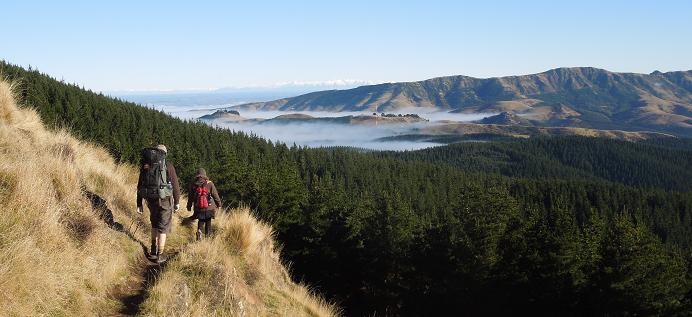
The first part of the "trail" is along farm roads. We avoided the odd logging truck by taking the side sheep trail, through dew drenched grass and prickly gorse bushes. Eventually, the trail separates from the road and we found ourselves wandering through rank ordered pine trees with trunks the size of 3 people. The ground littered in long needles made it difficult not to slip down the sometimes steeply slopping ground, but despite my new centre of balance being somewhere out in front of me, I managed not to fall. We wandered through the quiet forest, past grazing sheep and cows, into an open field, before coming over a rise and finding the aforementioned logging site.

This meant mostly noise, mud, and large machines. After carefully negotiating the slopping, muddy roads, we watched from the newly routed trail as bulldozers, grapplers, and harvesters made their way through the maze of massive standing and downed trees. Eventually though, we headed back into the forest (Douglas Fir this time - much darker, denser, and cooler) and on our way. An interesting observation from a pregnant hiker is the strange breathlessness that seems to overtake one on the slightest incline. While I had heard of this and considered it (it makes sense when you think of all your organs being pushed upwards, taking up precious lung space), there is nothing quite like experiencing it. Because, really, there is absolutely nothing you can do except slow down and accept that your lungs are working at reduced capacity. This was a great boon to our friends, who had worried they would hold us up with their slow pace. Instead, it seemed that I was the one bringing up the rear - yet another bonus point for introducing new trampers.


Finally, we emerged from the woods onto a bright sunshiny slope near the tops of the hills. The trail meandered past flighty sheep, amazing dyke formations jutting from the tussocky slope, and around the ridge to Kaituna Pass, and our final destination. We met a family just departing as we arrived, who had kindly filled the hut with fresh firewood and done a great job in cleaning up the hut. Soon, we were left to settle into the hut and relax for the rest of the afternoon. With both the Kaituna Valley and Lyttleton Harbor filled with fog, we felt like we were sailing above the clouds, with only the bleating sheep and cows for company.


After a fancy dinner of sausage and leek risotto, followed by pears with chocolate ginger sauce (all the stops were out to lure our friends into tramping), we settled into our beds to read and dream. Once the darkness had really settled in though, we were startled to see a line of little lights coming down Mount Bradley towards us. Stephen went out to investigate and met with a large group of runners training for an upcoming endurance run in Southland. Our friends were not so interested in this news, only whether they would have to end up sharing their room with more people (this was not something they were keen on). But the runners all decided to run home, and we were left to ourselves for the rest of the night - which despite our day of fog was bright and clear and absolutely filled with stars.
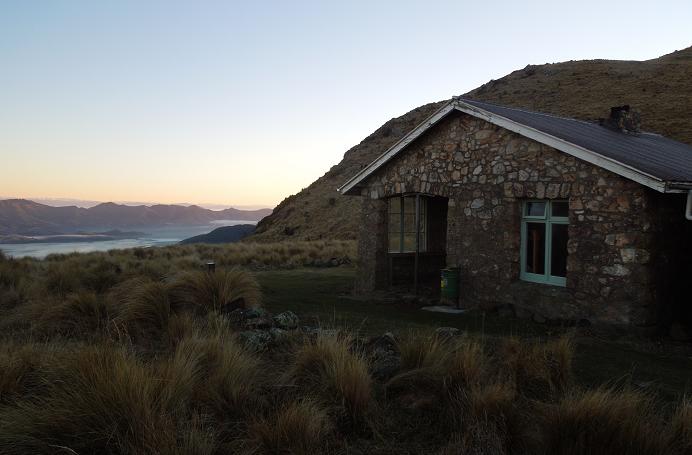
  

 The next morning, we awoke to find some of the fog lifted and some even more settled. We gobbled up some oatmeal (still the easiest tramping breakfast - though I'd be keen to hear of other peoples' favorites) and packed our bags. With the bright sun just coming over Mount Bradley we headed back down the hill (I was very impressed with the speed at which our friends were ready to go in the morning. Not sure if this is a good thing or not, though I did find out later that was the day exam results came out). Back across the tussocky slope, back through the now eerily quiet forest and logging site, and into the fog settled just above our car. Everyone smiling and laughing - a successful weekend all around.


Saturday, June 30, 2012

New Adventures

Since we moved here just over three and a half years ago, a lot has happened. We made new friends. We lost old friends. Stephen has become a teacher and got a permanent job. I have traveled to a place I'd only ever dreamed of going. We experienced a natural disaster. We lost our home. We bought our first home. We became residents to a new country. And now, we are expecting our first child.


Life is an amazing journey, full of new and unexpected adventures at every turn. We have enjoyed those which we have already experienced. And look forward to the new ones coming our way - over the next 20 years. I hear they're a real set of good ones.


Wednesday, June 6, 2012

Welcoming Winter

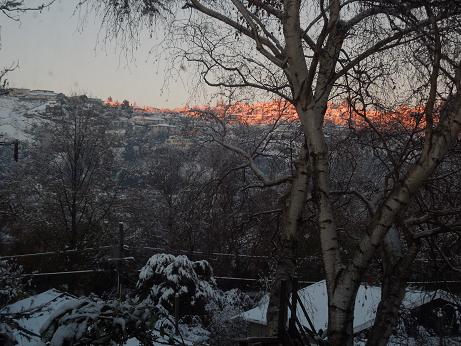
The view out the kitchen window this morning. Alpen glow, a rare occurrence in a city with no snow.
Yesterday it snowed here in Christchurch. Not quite as much as our previous dumps late last year, but enough to stick around for the last couple days and close schools and shops. And turn everything into a wintery wonderland. And while yesterday was grey and shivery (unfortunate for those wanting to witness the once in a lifetime event of the transit of Venus), today has been gloriously sunny and bright. Melting black ice which formed overnight on the roads and allowing trees to drop their heavy, wet loads of snow.

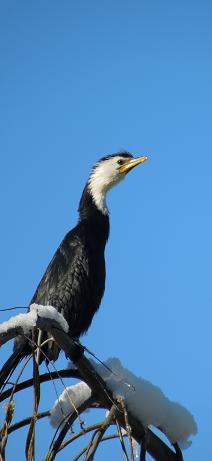
A shag sits atop a snowy tree by the Heathcote River.
Snow along the Heathcote river on the way to the library.
Icicles on Japanese Maple.
Leaves frozen to the pavement.
Walking back home from the library. A gorgeous day to be out and about.

Sunday, June 3, 2012

Tramping in the Nina Valley

Hmmm, where to begin after such a long break. So much has happened in the last few months. So many stories I've been meaning to tell. Perhaps they will make it here, or perhaps I will just move on to new things. Like our most recent trip into Lewis Pass to visit the Nina Valley.

It is currently early winter here in New Zealand, with snow beginning to dust the mountain tops and cool Southerly winds bringing in cold rain and chilly temperatures. Perfect weather for tramping in the mountains. Especially on a long weekend celebrating the Queen's Diamond Jubilee. So Saturday morning, after waking up we pulled together some food and gear and piled into the car at a leisurely pace, not pulling out of the drive until about 11am. With a 2 hour drive ahead of us, we were hoping for a relatively quick trip up to the hut to arrive before darkness set in.

After a quick stop in Culverden for some pitas and humus, we pulled up at Palmer Lodge, threw on our bags, and headed out to the trail. Because of our mid-afternoon arrival the sun had skirted up the valley sides and was just kissing the tops, glistening on the newly fallen snow there. But the air was clear and the birds were singing, so we headed off happily on our way.

Walking through the open beech forest


The Nina Valley trail starts with a gentle climb over a low spur to get into the actual valley itself. Afterwards, the trail follows the Nina River which is a lovely little river carving its' way through partly metamorphosed sedimentary stone. The valley is thick with beech, rocks, icy mud, and birds. There is a very active trapping program going on with a local high school, looking to eradicate the threat of stoats, weasels, and possoms. This left us with loads of robins, silver-eyes, and bell birds singing our way along the trail as we traipsed through mud, and over roots and rocks. At one point, we encountered a man coming back along the trail who warned us there were 18 people currently staying at Nina Hut which has 10 bunks. We thanked him for this valuable information and decided that tonight would be a great night to use our tent which Stephen's mom had so kindly brought with her at Christmas.


Surprise. I'm 5 months pregnant.

This was well timed news for us, as the light was quickly drawing up the valleys and it was good to know we should start looking for a good place to camp. Across a lovely swing bridge and down the trail a little further we came to a lovely grassy opening on the side of the river, just perfect for our wee tent. So with the tent up and the sun gone, we started in on a hearty chicken soup for dinner before the feeling completely left our fingers. After finishing off the soup and washing the dishes out in the river, we climbed into our wee tent and settled in for the night. I noticed the bright stars we had been watching while eating dinner were quietly disappearing behind banks of clouds coming in from the South.

Our wee camp on the edge of the forest.
The rain started at some point in the night. The million tiny sounds of each little drop hitting the fly filled the tent with a sort of calming white noise - as long as one didn't think about it being there in the morning. On and off through the night, I would wake up surrounded by the dark and the sound of water (not always sure of whether it was the river or the rain). Finally, the faint light of morning filled the tent to indicate the changing diurnal cycle and time for breakfast. Stephen kindly volunteered to go out in the rain and make the food, while I stayed in the tent and tidied gear away. Soon, oatmeal was brought into the tent and we gobbled it up before packing the tent away and headed back down the trail.

I always find it funny the way trails you've been down once before seem so much shorter than before. As if the knowledge of what to expect around the next bend  makes it appear that much sooner. So, despite the ongoing drizzle and general greyness to the day, we were soon hearing the whizzing of trucks and cars along the highway. Once back at the car, we changed into some dry clothes, popped open the requisite bag of potato chips, and drove off towards home. 


Almost a full moon.

Wednesday, February 8, 2012

Writing

Hello to those of you still checking this poorly updated site. I have to apologize for not writing for so long. I have finally begun the massive write up for my thesis and feel little inclined to write in my free time. So, rather than discuss our continuing international food experiments (off and on I must admit) or tell you about our various tramps (which I will try to get to eventually) or ramble on about our impending residency (which will definitely show up), I will offer some of my reflections on Antarctica. As part of my exploration of the perceptions of Antarctica by New Zealanders I have been doing self-reflective writing throughout my studies. They talk about where my original ideas and drive rose from and how my research and experiences have influenced and changed my perceptions. It is not often we take the time to reflect on how experience changes our perceptions, but I offer the idea that taking the time now and again can help us understand not only how we affect places or events, but also how they affect us.
_____________

10 Mar. 09

The first time I remember wanting to go to Antarctica was the summer of 1998 when I was in Britain with my family on a holiday. We were in Bath staying in Beckfords’ Tower, a landmark trust property. I had just purchased a book about Shackletons’ Endurance expedition in order to write an essay for a Canadian essay competition. It was a big picture book, with stories and photos from their journey. I learned about how their ship sank into the ice, how they lived on ice floes for months on end, how they survived on penguin and seal meat, how 6 of them made an amazing 700km voyage in the open seas in a tiny boat to South Georgia to rescue the rest of the crew, not one person dying, I learned where South Georgia was. After that, I read South by Shackleton himself. Retelling in detail what this vast and distant continent was for him. And I was hooked.

Growing up in the North, I have an understanding of cold and snow and ice. I know how to make an igloo, a quinze, a snow trench. I know how to stay reasonably warm in -30oC with the wind whipping the heat away from your body. I have skied on a glacier. I have slept over night in the snow. I have experienced a whiteout. But I have never experienced Antarctica. I know deep down it is different. I know that the experiences I have had will be vastly different from any I could have in Antarctica, but they must count for something. They must have some relation to what one encounters and the other end of the world. In Antarctica.

Shackleton's ship in 1915

Antarctica was always white to me. It was blowing snow across a vast, flat white surface. Even the mountains I pictured were white, no rock, just snow. There were beaches of limited black rocks, but everything else was white. I got these images from reading about Shackeltons’ Endurance expedition. The old photographs of black and white taken by Hurley showed nothing but white on white with wisps of gray thrown in for shadows. Sure there were little people all in black, most of which I later learned were drawn in by Hurley to produce a sense of scale. But it didn’t really matter; Antarctica was this vast, blank continent, filled with the lonely stories of Shackleton, Scott, and Amundsen. I wanted to see it for myself, to experience this desolation, this emptiness, this hollow country of snow.

After our trip to Britain, Antarctica didn’t quite disappear, but it certainly dropped from the centre of my mind. I adopted a strong fondness for penguins and learned as much as I could about them. I read different stories in the news about Antarctic science. But it was all very far away. It felt almost on a different planet. I loved the Yukon, the North, Canada, and I worked hard at learning about my home. About the plants that grew there, the birds and animals that lived there, and the different histories that made it the place it is today. But it’s interesting being raised in a country I know is not my cultures’, in a land that is nothing like the places my grandparents’ or even my parents’ told of in their stories, in a place that is filled already with the stories of other peoples’ traditions and ways of life.

My father was always aware that we were settlers, new comers, immigrants, and even though I was 6 when we arrived and I grew up there, I have this feeling of not quite belonging. I want to go back, I want to raise children there, and make my family there, but I know and always will know that I have a very different connection to the land than do the Athabaskan, the Tlingit, the Gwitch’in. I value and love the spaces and places I have come to know, Egg Island, the 30 Mile River, Magic Pony hill, Lake Laberge, but these are different values and connections than those of the First Nations who have been there for generations. And this is probably the biggest reason I came back to Antarctica in my mind. The idea of tabula rasa that Antarctica epitomized grabbed my mind and drew me to it. As a second generation Canadian and first generation Yukoner, I was acutely aware of my not quite belonging. I longed to feel that deep connection that I imagined the Ta’an Hwitch’an felt for the places I loved so much, I wanted to belong to some place. I imagined that Antarctica might hold that key. Now I’m not so sure that it actually holds the key to my feeling a sense of deep connection to the place, but perhaps it is instead showing me how to belong in the Yukon. I will have to wait and see.

Tuesday, November 8, 2011

Global cuisine - Turkish

Hmm, it's been a while. We have been following our pledge. I've just been rather lousy at posting about it. After our week in Morocco, we continued across the Mediterranean to Turkey. While I have always wanted to visit Istanbul and Hagia Sopiha, I have had very little idea about what Turkish food consisted of.

[Sorry, no food pic this time - pilaf isn't really that photogenic. Instead, a lovely picture from Lonely Planet of Istanbul, a city I long to visit]

I should admit now, it is a lot more work than I anticipated cooking a country a week. You have to choose a country, thinking about what's in season and available at that time of year. You have to find recipes (my two favorite places have been the internet and the public library) and choose those which coincide with seasonally available produce (at least in my mind you should). Then you have to track down any specialty ingredients you might need (Japan - Saki, France - Duck fat, Turkey - Grape leaves). And each night, after work or school, you have to be up for learning new techniques and trying new things. Don't get me wrong, it's a blast. But it has resulted in me looking for the simplest meals at times - which I suppose is something someone from any country would do after a long day of work. Leading me to admitting that while cooking Turkish food, we ate a lot of pilafs.

Pilafs are awesome. Essentially, rice, barley or couscous cooked in a flavoured broth with tasty bits added in. They take rice to a whole new level for me and the recipe I have below was my absolute favorite of the lot. While it only has 6 ingredients, the flavours are rich and delicious and the ingredients are super easy to find.

Chickpea Pilaf
1 can drained chickpeas (390g net)
175 g long-grained rice*
1 onion, chopped
2 Tablespoons butter
600ml stock (I like chicken)
1 large bunch of spinach, washed and chopped
Pepper to taste (salt is in your stock)

1) Melt butter in large pot, or wok, and add onions. Cook until soft. Stir in chickpeas and rice. Pour in stock, season with pepper and bring to the boil. Reduce the heat and cook, stirring often, until almost all liquid has been absorbed. Stir in spinach until it wilts in.

2) Remove pan from heat, cover with a clean, dry teatowel and press the lid down tightly. Leave to steam 15-20 minutes.

3) Fluff gently with a fork and serve.

*I am learning so much about the different types of rice, how they vary taste-wise and cooking-wise. It's great.

Another one?!

So far, we seem to average about one a year. Which, depending on how long we stay here, could amount to a fair number of cats.

While he was doing security rounds at school on Monday night for the end of year awards ceremony, Stephen had to haul this wee cat out of the performance centre which she was trying to infiltrate in order to pilfer the prizes. He called me up at home and requested I come get her as he was pretty sure she hadn't eaten in a while. So, I gobbled up the rest of my dinner, jumped in the car and drove on down to the school. Sure enough, the cat almost jumped into the crate in order to get the fresh fish and bowl of food I'd brought along. Once home, I tucked her into the bathroom with a hot water bottle and some more food and water. I think I've seen her up on her feet about 5 times since then (2 days later) and one of those was to go to the vet. She is one tired kitty. Hopefully, she'll be back on her feet in a few days and we can get to know her a bit better.

Meanwhile, we'll wait to see if someone is missing her. Otherwise, well, time will tell . . .