Showing posts with label Antarctica. Show all posts

Sunday, November 14, 2010

Heading South

Well, once again I have been fortunate enough to get myself a trip Southward. In two days time (early Wednesday morning), Stephen will drop me off at Antarctica New Zealand and I will climb aboard a huge plane to emerge into spacious whiteness. This time I am travelling to Antarctica as a research assistant to my supervisor on his research examining the behaviour of scientists in the field. Focusing especially on the choices they make that relate to environment sustenance or degradation.


During my time in Antarctica I will be maintaining a blog for Science Alive, a local Christchurch science centre. This means I will probably not post much on here, but you are more than welcome to follow my adventures while on the ice at http://psychologyinantarctica.blogspot.com/


Saturday, May 8, 2010

Antarctica: Just another place?

My first public lecture took place this past week. Wednesday evening from 6:30 to 8pm. Mine was the first in a series of four lectures on the different aspects of Antarctica. I was terrified. I have never had to present something for an hour and a half, keeping people interested and engaged in what I have to say. Especially since it was on the theory behind my research. Who would want to hear that?! As it turned out 26 people did (among them my supervisor and three peers from Gateway). I had been preparing for this talk for about 3 weeks, getting slides together, thinking about what to say and what to do to keep people interested. And suddenly it was Wednesday morning, I still had slides to finish and ideas to cement. Aaaaahhhh!!!

But you know what it went well. In fact it was amazing. People listened to my every word, they asked questions, they looked thoughtful when they heard what I had to say. What a novel feeling; to have people pay money to hear me talk about my research, my interests, my passions.

I know mom and dad wanted to hear about it so I've come up with a mini written version for here. Read it if you like or save it for when you're really bored or just leave it. All up to you.
___________________________________________________


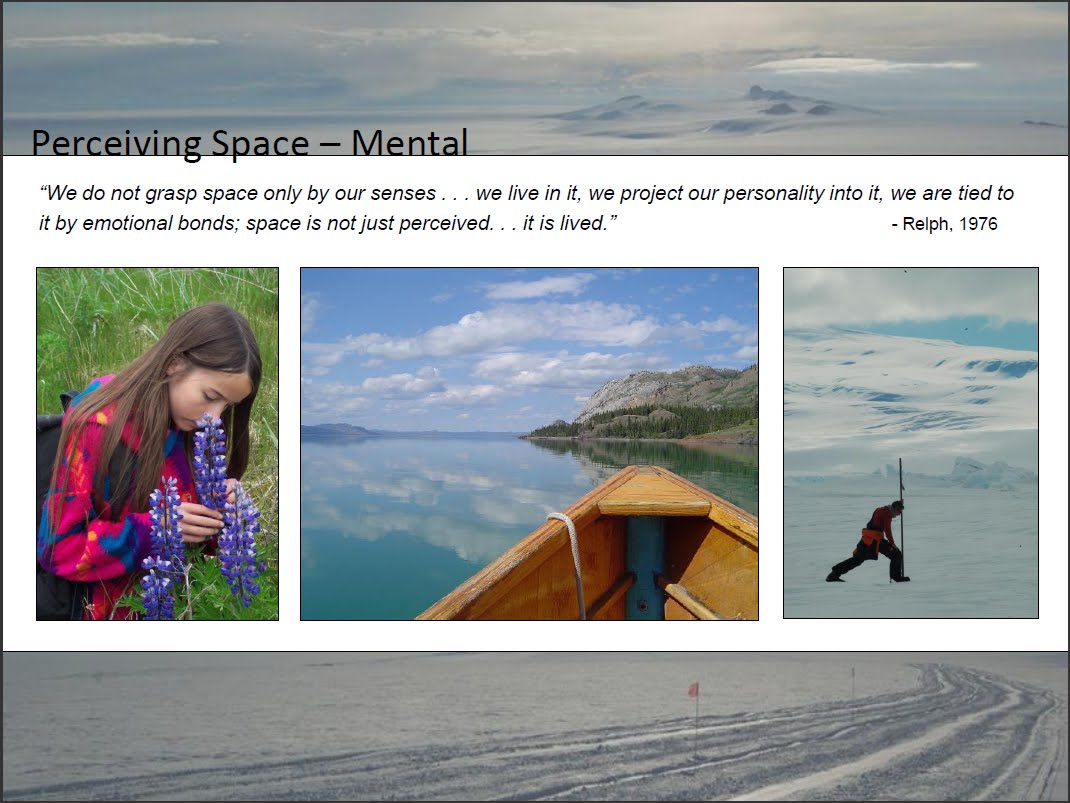
We often go through life without taking much thought as to how we come to see the world around us. It just is and we're happy enough to just accept that. But how do we come to perceive and understand the places we've never been to? How can we care so much for distant lands we may never experience ourselves and not care enough to pick up the pieces of trash we pass in the streets of our own homes? It is these questions that shape my research on New Zealanders connections to Antarctica. And the focus of this little segment is on the theory behind how we perceive and put meaning on far away places like Antarctica.


We perceive the world around us through our bodies and our minds. Using our five senses, sight, hearing, smell, taste and touch to learn about the environment we are in and our minds to help guide our senses and put meaning on what we see. The different ways we use our senses shapes how we associate meaning to what we sense. For example, sight is often our most relied upon sense. And in a way it is seen as our most objective sense, we see the world around and outside us. We are able to observe what happens around us without influencing what we are seeing. It allows us to remain distant and removed from the environment around us. Our other senses, like hearing, smelling and taste on the other hand require environmental information to physically enter our bodies. The sounds we hear enter in through our ears (holes in our head), smells waft in through our noses and the things we taste enter our mouths and feed our bodies. These are subjective and our interaction with them changes them (or us), making them far more emotional. Our sense of touch is one of our most intimate senses and although we have the saying "seeing is believing" our sense of touch is associated strongly with trust and truth. Think of the act of pinching ones arm to verify that you are really experiencing whatever it is you are experiencing.


Our minds also play a role in what we perceive around us. Our interests and purpose in an environment will determine what we notice and look for, thus shaping what we take in. Our personal experience and knowledge, our ideas, beliefs and values all work together in shaping the environmental information we receive from our bodies and give meaning to the environments we experience. The same space experienced by different people can mean very different things; Mount Erebus on Ross Island in Antarctica was the sight of a tragic tourist overflight crash in 1979, so for many, Mount Erebus is grave, a memorial, a sad place. Mount Erebus is also a peak to be climbed by those strong enough to endure the physical and mental challenges offered by an Antarctic mountain. It is a volcano to research. It is a scenic prominence to paint or photograph. It all depends on who you are, what you know, what you believe and so much more.

So our bodies bring in environmental information and our minds help direct our bodies and apply meaning to what we see. We bring these things together and create a sense of a place. Sense of place is an ever evolving idea, it is never complete and changes as you change. It is based on who you are, what you know and the experience you have of the place. This is where Antarctica is very different from most other places, because for most people the experience they have of Antarctica is had through museums, books, movies and other peoples stories. So an Antarctic sense of place is commonly built on the senses of others. This brings up an interesting question hotly debated in the human geography realm of sense of place and that is whether the physical environment plays an important role in determining our sense of place.


Constructionists believe that the physical environment plays no role in shaping our sense of place. They believe that a sense of place is purely shaped by our minds, the meanings we place upon a landscape are the only meanings present. Thus, Antarctica would not be the Antarctica we know without us thinking about it. On the other side of the coin, Being-in-place theory suggests the physical environment does play a role in determining how our sense of place is shaped. Either by the sheer fact that the physical environment will determine how we interact with it and therefore shape the meanings we associate with it, or by the idea of genius loci. This is Latin for "spirit of the place", it refers to the idea that every place has a spirit of its own and it is this that we are experiencing when we experience a place. It is this spirit that artists commonly refer to trying to capture in their artwork and share with others.

So whether we believe the physical environment plays an important role in shaping our sense of a place or not, we all sense place. For a place like Antarctica, where most people do not get the opportunity to experience the place first hand, those experiences are shaped by stories from people who have been there, movies based on or about the continent, books, advertising that uses certain images to sell their products, museums and other such things. We are left with these second-hand sources of information to form our sense of place. Although they all range in the visions, sounds, ideas and feelings they propose for Antarctica, they all work to create an idea of the place. Integrating this information with who we are, what we already know and believe, we come up with Antarctica. Our own version, unlike anyone elses.

___________________________________________________

There you have it. A summarized version of my talk. Now I just need to squish that down into 10 minutes and I'll be set for Oslo and Hobart!
Monday, February 1, 2010

Christmas on Ice, Part 4 - Scott Base

Arriving back at Scott Base after 10 days in the field was absolutely wonderful, if a little shocking. Hot showers, other people, no need to spend hours melting snow into water so you don't dehydrate the next day, flush toilets. Ahhhhhh, all we had to do before we could enjoy any of that (except of course the toilets) was clean up all our gear. . .

Clean up included washing and drying all sleeping bags, all dishes, all cook boxes, stoves and cutlery, emptying food boxes of any leftovers, airing the tents and then putting it all away. Oh yeah, and someone had to deal with all the shit.

Finally we could enjoy the pleasures of the kitchen. . .

the common room. . .

and yes, even the hallways that connect everything together.

Of course, with McMurdo Station only a 2km walk away, a trip over (or two) was essential, if only to visit the gift shop ;) Observation hill is the tall mountain-like thing on the left.

McMurdo is very different from Scott Base. Mostly it's just bigger.

And a little bit messier.

But it has a really cool collection of weird and wonderful toys to play with. We were lucky enough to catch the tail end of an art show that took place at the carpentry shop there. Chrissie and I are demonstrating the joys of a homemade seesaw.

Someone had also made one of those cool executive desk bouncing ball type thingys out of bowling balls. It was cool.

It was amazing to see and experience the differences between Scott Base and McMurdo. Where Scott Base reminded me more of a mining or exploration camp with its tight knit community and completely self-suficient lay out, McMurdo reminded more of a mining town, sprawling, mucky, and big, everything there was big. You can see Discovery Hut in the foreground here, unfortunately, due to proximity to people, this hut has been heavily looted.

The view of McMurdo from atop Observation Hill. The big white circle tanks are holding all the fuel needed for Scott Base and McMurdo to run for a year, including petrol, diesel, and jet fuel.

Scott Base on the walk home from McMurdol. So different.

Just a pretty picture of the pressure ridges around Scott Base.

Why didn't they show this to me earlier? It so would have helped me avoid all the awkward situations I had with penguins on my trip. I thought he just wanted to dance.

Sign says it all. The building in the background is the kitchen and common room.

Erebus out beyond the pressure ridges on the day we left. A lovely farewell from a cold continent.
Everyone waiting for the plane to park.

Then we were off. Back into the great, grey warehouse, into the sky and home again.

Christmas on Ice, Part 3 - Camp

With thousands of pictures to sort through I've tried hard to keep it light, but have admitted a certain defeat with this next lot. I have decided to let the images do most of the talking. So browse through them, read the captions, and if you want to know more, just ask. This is my photo essay of our time while camping in Antarctica. Enjoy.
______________________

Putting up the polar tents. Two people slept in each tent, but the more help you got putting it up the better.

The toilet. Antarctica is a "bring it in, bring it out" kind of place, so the yellow bucket collected poo and the white box collected pee. After 10 days of living in the field a certain level of finesse was acheived for peeing into small openings.

Camp. Crystal and my tent is on the left, in the foreground is our little snow kitchen.

Flags marking the way to Scotts Hut at Cape Evans. The flags are left in place until there is nothing but bamboo left, this takes anywhere from 2-10 seasons depending on the location, whether is protected from wind and snow.

Captain Scott's hut built at Cape Evans. With strict regulations in place and extensive restoration work, this is one of the most amazing museums I have ever been to.

A chemistry set from Scott's Hut.

Lots and lots of cocoa.

Preserved for almost 100 years both the penguin and the paper show little sign of decomposition.

Inside the hut.

Driving the hagglund with Girard. Built in Sweden, these machines are also used for warfare in desert countries as they work well in sand. If you look around the machine you can see the various mountings for machine guns and other things.

Off to look for seals. The long poles are to test the sea ice as we walk along. Because seals come up and hang around holes in the sea ice, we have to be careful not to fall into any nearby cracks or breathing holes.

One of the highly photogenic seals. Proabably a pup from that year.

Our Christmas feast. Some of the students spent Christmas eve digging out this table for us to share our meal around. On Christmas day, Santa (and his twin and three elves) came out to deliver us a delicious and HOT dinner of turkey, ham, gravy, kumara, veggies, cookies, cake and merangues. It was amazing. Unfortunately, it was also the coldest day. No matter. Everyone enjoyed the food, the company and the stunning view from the dining table.

Most days we were out of camp, driving around in Hagglunds to carry people to various places. This is on one of the lovely crystal clear days we had after Christmas.

One of the fanciest kitchens built, but really it wasn't all that fair, they had a carpenter in their group.

One of the projects the students did was on snow compaction. This is a 6 metre long drill core they took to examine crystal deformation.

Another project was looking at the geology of Castle Rock.

Part of that project included climbing to the top of it.

The view as I emerge from my tent on a bright sunshiny day, or is it night, I can't tell.

Late on boxing day night, Crystal, Sean and I took off on the skidoos to get a better view of Erebus and just generally escape camp. It was amazingly still, quiet, and wonderful. We just sat there for almost an hour and didn't get back to camp until about 1am.

On the last day in camp we pulled up some ablation stakes a "real" scientist had set out the previous year to measure loss of snow or ice mass in the area. It was a hard four hours of trudging through thigh deep snow stopping every 100 metres to pull up a 2-6 metre tall stake. Despite the overcast sky and chill temperatures, we ended up in nothing but sweaters and gloves. Once we had pulled up all 81 stakes, we headed back to camp and packed up for our return to Scott Base the next day.

Wednesday, January 20, 2010

Christmas on Ice, Part 2 - Arrival

Finally, we came to a stop. We could unbuckle our seat belts, pile on our ECW gear and get off the place into the wide, white world beyond.

And man oh man was it white. Although the temperatures made all our survival gear a little overkill, the sunglasses were definitly necessary. Everyone had smiles the size of saucers and cameras were clicking everywhere.

We were guided off the runway by military personel towards our next transport, Ivan, the Terra Bus.

After a half hour of driving across ice and snow, we bumped up onto solid ground and drove into McMurdo where we switched from bus to truck and drove over to Scott Base. Driving into McMurdo reminded me so much of Inuvik. Gravel roads, dusty everything, and lots of metal, square buildings. The 2km drive from McMurdo to Scott Base goes up between two extinct volcano cones to emerge on the otherside of the Hut Point Peninsula. The kiwi base, in comparison to the American one, is tiny and green (not in reference to environmental awarness, just colour) and it reminds me more of a mining camp all self contained (hallways connect each building so there's no need to leave the comfort of the indoors). We were ushered from our vehicles, into a big green, steel building and up into a warm little room where we learned the basics of staying in Antarctica and on Scott Base.

After a delicious dinner, served in the cafeteria, we all took a walk down to the sea ice. Just a few hundred meters in front of Scott Base, where sea ice is pushed up by the tides, are a collection of pressure ridges scultped by the sea and the wind. It is a beautiful, ever changing gallery of crystalline forms and scattered in amongst the colunms are the most regular visitors, the Weddell seals.


We wandered back towards base where some of the students scrambled into costumes to join in the fun of the James Bond party being held that night at the base bar.

The next morning, before packing, we went up Crater Hill, the volcano behind Scott Base. It was pretty windy and not very sunny, but the temperatures hovered around -7 degrees centigrade and everyone enjoyed the views.

These are the first 3 wind turbines in Antarctica. They were just coming online while we were there. It is expected they will reduce the amount of desiel used by both Scott Base and McMurdo by ~11%. There are some people who question their usefulness here and don't like the aesthetic impact they have, but I wonder if we are to continue being down in Antarctica for scientific purposes because of it's "early warning" capabilities with regards to climate change shouldn't we at least be trying to reduce our footprint to be here?

One of the students enjoying the small comfort a wind block wihle at the top.

McMurdo from Crater Hill.

Walking along the edge of the crater. In the background and to the left, Mount Erebus hides behind some clouds.

Heading back to base, ready to start packing for our next big adventure. Camping on the ice shelf.

While everyone packed food and tents and cooking stuff, Crystal, Steve, Sean and I met up with Alex to get our licences for driving on the ice. We were taught how to drive Hagglunds, skidoos and trucks (Landcruisers to be precise - although the only difference I noticed was that the top speed was 20km/h). That night, our personal and group bags packed, we snuggled into bed for one last night in a warm room. The next morning we would be leaving nice and early to get out to camp and set up our tents and dig some pits. It would be a busy day.