With thousands of pictures to sort through I've tried hard to keep it light, but have admitted a certain defeat with this next lot. I have decided to let the images do most of the talking. So browse through them, read the captions, and if you want to know more, just ask. This is my photo essay of our time while camping in Antarctica. Enjoy.
______________________

Putting up the polar tents. Two people slept in each tent, but the more help you got putting it up the better.

The toilet. Antarctica is a "bring it in, bring it out" kind of place, so the yellow bucket collected poo and the white box collected pee. After 10 days of living in the field a certain level of finesse was acheived for peeing into small openings.

Camp. Crystal and my tent is on the left, in the foreground is our little snow kitchen.

Flags marking the way to Scotts Hut at Cape Evans. The flags are left in place until there is nothing but bamboo left, this takes anywhere from 2-10 seasons depending on the location, whether is protected from wind and snow.

Captain Scott's hut built at Cape Evans. With strict regulations in place and extensive restoration work, this is one of the most amazing museums I have ever been to.

A chemistry set from Scott's Hut.

Lots and lots of cocoa.

Preserved for almost 100 years both the penguin and the paper show little sign of decomposition.

Inside the hut.

Driving the hagglund with Girard. Built in Sweden, these machines are also used for warfare in desert countries as they work well in sand. If you look around the machine you can see the various mountings for machine guns and other things.

Off to look for seals. The long poles are to test the sea ice as we walk along. Because seals come up and hang around holes in the sea ice, we have to be careful not to fall into any nearby cracks or breathing holes.

One of the highly photogenic seals. Proabably a pup from that year.

Our Christmas feast. Some of the students spent Christmas eve digging out this table for us to share our meal around. On Christmas day, Santa (and his twin and three elves) came out to deliver us a delicious and HOT dinner of turkey, ham, gravy, kumara, veggies, cookies, cake and merangues. It was amazing. Unfortunately, it was also the coldest day. No matter. Everyone enjoyed the food, the company and the stunning view from the dining table.

Most days we were out of camp, driving around in Hagglunds to carry people to various places. This is on one of the lovely crystal clear days we had after Christmas.
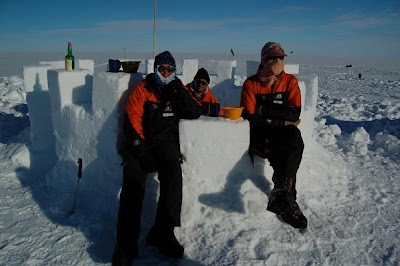
One of the fanciest kitchens built, but really it wasn't all that fair, they had a carpenter in their group.

One of the projects the students did was on snow compaction. This is a 6 metre long drill core they took to examine crystal deformation.

Another project was looking at the geology of Castle Rock.

Part of that project included climbing to the top of it.

The view as I emerge from my tent on a bright sunshiny day, or is it night, I can't tell.

Late on boxing day night, Crystal, Sean and I took off on the skidoos to get a better view of Erebus and just generally escape camp. It was amazingly still, quiet, and wonderful. We just sat there for almost an hour and didn't get back to camp until about 1am.

On the last day in camp we pulled up some ablation stakes a "real" scientist had set out the previous year to measure loss of snow or ice mass in the area. It was a hard four hours of trudging through thigh deep snow stopping every 100 metres to pull up a 2-6 metre tall stake. Despite the overcast sky and chill temperatures, we ended up in nothing but sweaters and gloves. Once we had pulled up all 81 stakes, we headed back to camp and packed up for our return to Scott Base the next day.
 Clean up included washing and drying all sleeping bags, all dishes, all cook boxes, stoves and cutlery, emptying food boxes of any leftovers, airing the tents and then putting it all away. Oh yeah, and someone had to deal with all the shit.
 Finally we could enjoy the pleasures of the kitchen. . .
 the common room. . .
 and yes, even the hallways that connect everything together.
 Of course, with McMurdo Station only a 2km walk away, a trip over (or two) was essential, if only to visit the gift shop ;) Observation hill is the tall mountain-like thing on the left.
 McMurdo is very different from Scott Base. Mostly it's just bigger.
 And a little bit messier.
 But it has a really cool collection of weird and wonderful toys to play with. We were lucky enough to catch the tail end of an art show that took place at the carpentry shop there. Chrissie and I are demonstrating the joys of a homemade seesaw.
 Someone had also made one of those cool executive desk bouncing ball type thingys out of bowling balls. It was cool.
 It was amazing to see and experience the differences between Scott Base and McMurdo. Where Scott Base reminded me more of a mining or exploration camp with its tight knit community and completely self-suficient lay out, McMurdo reminded more of a mining town, sprawling, mucky, and big, everything there was big. You can see Discovery Hut in the foreground here, unfortunately, due to proximity to people, this hut has been heavily looted.
 The view of McMurdo from atop Observation Hill. The big white circle tanks are holding all the fuel needed for Scott Base and McMurdo to run for a year, including petrol, diesel, and jet fuel.
 Scott Base on the walk home from McMurdol. So different.
 Just a pretty picture of the pressure ridges around Scott Base.
 Why didn't they show this to me earlier? It so would have helped me avoid all the awkward situations I had with penguins on my trip. I thought he just wanted to dance.
 Sign says it all. The building in the background is the kitchen and common room.
 Erebus out beyond the pressure ridges on the day we left. A lovely farewell from a cold continent.
 Everyone waiting for the plane to park.
 Then we were off. Back into the great, grey warehouse, into the sky and home again.


